
Partial dentures are used to replace various missing teeth. These cannot be given to people who have a complete arch of missing teeth. Partial dentures are also an option for people who do not want to go for crowns and bridges. We deliver all types of dentures at Vasai Dental Care and implant Clinic.
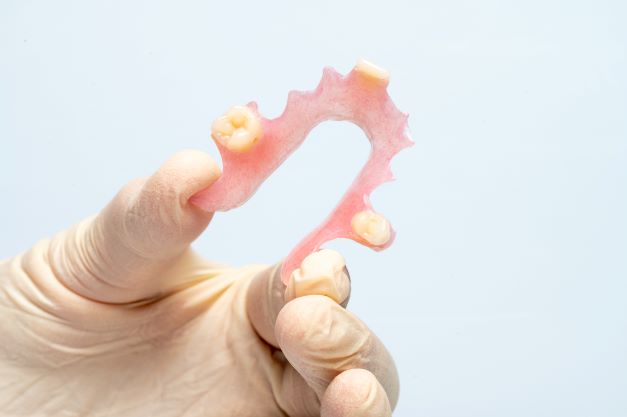
Partial Dentures
What are the indications for partial dentures?
- One or more missing teeth
- Few healthy teeth present
- Crowns and bridges are not an option.
- Temporary prosthesis before crowns and bridges
What are the advantages of removable partial dentures?
- Less invasive then than fixed partial dentures. The removable dentures do not alter the adjacent teeth like the fixed partial dentures.
- They are better than complete dentures in a way that they have support from the alveolar bone, mucosal tissues, and the remaining teeth.
- Additional teeth can be added to the partial denture over some time.
Disadvantages of removable partial dentures
- They can cause accumulation of plaque around the remaining teeth and can cause decay of the abutment teeth. Since they take support from the remaining teeth, their movement can cause pressure or trauma to the adjacent teeth.
- The comfort level of the removable partial dentures is less than implants and fixed partial dentures.
What are the different types of partial dentures?
- Acrylic dentures: These dentures are made up of a pink acrylic base. The base resembles the natural colour of the gums and the teeth are fixed over them. Metal clasps are attached to the acrylic base and these clasps take support from the remaining natural teeth.
These are ideal for patients who may lose their remaining teeth in a short period due to any periodontal or other condition.
- Cast partial dentures: These are stronger, durable, and have more retention as compared to the acrylic partial denture. The fabrication is technique sensitive and time-consuming but these dentures are a great form of removable replacement of missing teeth.
These function well in cases where the periodontal condition of the remaining teeth is good. They are also a good form of replacement in cases where there is a long edentulous area behind the remaining natural teeth.
They are not indicated in cases where the patient does not maintain good oral hygiene and has periodontally compromised teeth. They are also not indicated in patients who have rampant caries.
Procedure for the cast partial denture:
- Impressions of the upper and lower arches. Models are fabricated for further procedures.
- Preparation of the abutment teeth: The abutment teeth are modified a bit to receive the cast partial denture. A metal framework is sent to the laboratory for fabrication.
- A metal framework is tried in the patient’s mouth and the bite is registered. This is sent to the lab.
- Trial of the dentures: Artificial teeth are fabricated on the metal framework and tried in the patient’s mouth. This denture is tried for phonetics, aesthetics, and proper fitting
- Delivery of the denture: The dentures are inserted into the patient’s mouth and checked for fitting and stabilization. The aftercare instructions are given to the patient.
- Recall: After any type of denture is delivered, the patient has to come for a recall so that the dentist can come to know about the discomfort or problems associated with the initial wear.
Flexible dentures: These dentures are made up of thermoplastic material. These dentures are pink in colour like the acrylic dentures.
Advantages of the flexible dentures:
- They are slightly flexible and adapt better to oral tissues.
- Give a more natural appearance
- Are more durable and are highly resistant to fractures.
They are prone to plaque build-up around them so they should be cleaned well. You may have to replace your flexible dentures if you lose your natural tooth.
Dr. Ajay Mishra and Dr. Pallavi Taneja are specialists in giving complete and partial dentures in one day.
Taking care of your dentures:
- Clean your dentures once before wearing them in the morning and once after you remove them in the night before sleeping.
- Remove your dentures before going to sleep: Your oral tissues need to relax and hence the dentures should be removed at the night.
- Put them in water when you are not using them.
- Visit your dentist if your dentures fracture or do not fit well.