
Dental implants are the artificial root structures that are placed in the jaws. Implants are inserted in the place of one or more missing tooth structures. Dental implants act as an anchor for prostheses like dentures or crowns. Implants are the most advanced technology for missing teeth replacement.
At Vasai Dental Care and Implant Clinic, we are the proud owners of all the types of equipment and skill to deliver high-quality implant treatment.
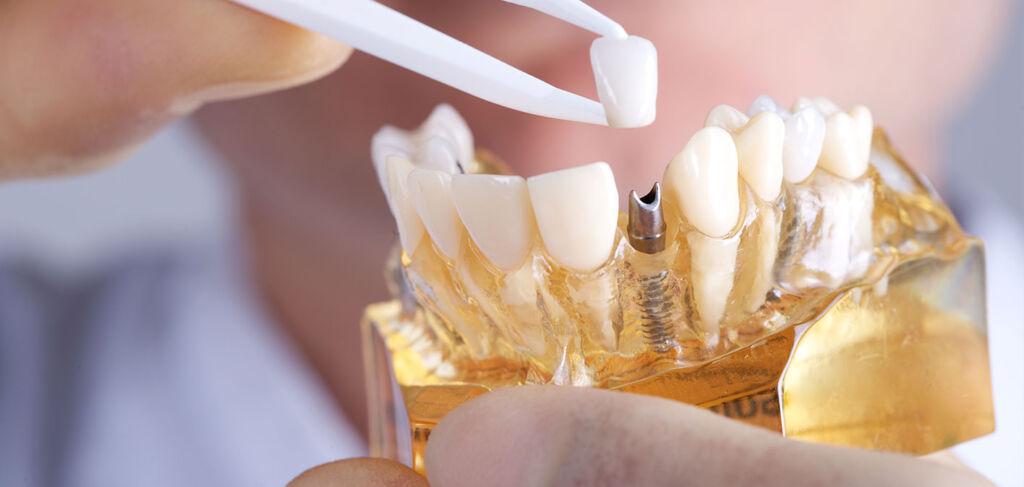
Dental Implants in Vasai
Are implants better than the other form of tooth replacements?
Yes. Implants are better than fixed partial dentures and removable dentures in the following ways
- They give a more natural appearance to the face since they are placed inside the bone and the crown is placed over them. It is the closest imitation of the natural tooth.
- No damage to the adjacent tooth structure: The bridges or the fixed partial dentures take support from the adjacent teeth. This can make them prone to caries and sensitivity. The implants on the other hand do not cause any damage to the adjacent teeth.
- While dentures have to be removed from the mouth and cleaned, implants are fixed.
- Conservation of the alveolar bone: The alveolar bone is the part of the bone that holds the tooth. Once a tooth is removed, the surrounding alveolar bone starts resorbing. The loss of alveolar bone can cause the adjacent muscles to sag and give a dull appearance to the face.
- Long-lasting: Dental implants have a very high success rate. They last more than the conventional dentures and the bridges.
- Better functionality: They provide better chewing and biting efficiency.
Different types of implants
- Endosteal implants: These are the conventional implants placed in the jawbone. They are used in the patients who have good bone support. The implants are left to integrate for some time and then an abutment is placed over it that holds the crown.
- Subperiosteal: These implants are not placed inside the bone. Instead, they are placed under the gums but just above the jawbone. Then a metal frame with a post is placed under the gum. The gums eventually heal around the metal frame.
The teeth are placed over them after this integration.
This procedure is done only when the patient does not have enough bone support.
- Basal implants: Basal or the cortical implants are placed in the cortical portion of the jaw bone. The basal bone is strong and provides good retention. The basal bone is dense and hence less prone to resorption. The bone is resilient and has a greater load-bearing capacity.
Alternative implantology techniques
Ideal bone support is required for the placement of implants. In cases where the bone support is not adequate, some alternative methods can be used to augment the bone support like:
- Ridge augmentation: When your natural teeth have been missing for a long time, the alveolar bone undergoes resorption. Bone augmentation helps to increase the volume of the bone. This can be done with the help of bone grafts. The bone graft material is placed at the deficient site surgically and then the gums are sutured back over it.
- Sinus lift: This procedure involves increasing the bone support in the posterior maxilla, specifically in the area of molars and premolars. This is done surgically with the help of bone grafts. The grafts are placed and left to heal for around 4-6 months.
The grafts promote new bone formation. The bone is ready to take implants.
- Ridge Expansion: When the bone lacks adequate width, the ridge can be expanded with the help of expanders like chisels and osteotomes. The space created can be used for the placement of implants and grafts. This technique has an advantage as it does not require waiting period of 4-6 months.
What are the post-operative instructions for dental implants?
- Do not rinse or spit out for 24 hours.
- Start cold compression immediately after surgery.
- Have only soft and liquid diet
- Take the medication prescribed by your doctor
- Avoid smoking for a week
- Avoid any strenuous exercise for 3-4 days after the implant surgery
- Keep the surgical site clean with the help of mouthwash and warm saline rinses. These have to be used 24 hours after the surgery.
- Keep yourself hydrated. Your fluid intake should be high.